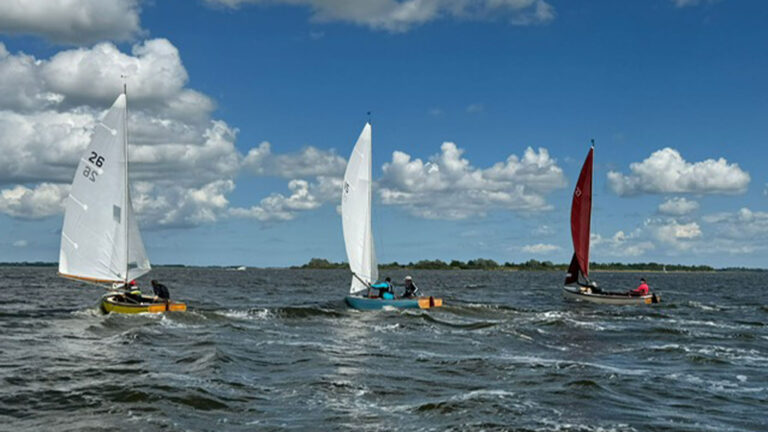
The Sprite is a One-Design, 14' clinker-built, centre-board, half-decked sailing dinghy, originally designed for West Mersea Yacht Club by Robert N Stone in 1934.
November 2008
Aims To provide an up-to-date set of rules to which boats can be better measured to obtain a certificate, to provide fair racing for those still sailing after 60 years with boats which have been re-built to prolong the life of the Class, and to prevent it being split into two separate groups, To reduce the hassle of re-measurement….!
THE SPRITE CLASS ARTICLES OF ASSOCIATION
A1 OBJECTS
(a) To promote and maintain the Sprite as a strict One-Design Class.
(b) To administer and control the Sprite Class.
A2 MEMBERSHIP
A voluntary Association of Sprite Owners who are members of The Blackwater Sailing Club and who own a Sprite.
A3 VOTING RIGHTS
Each Sprite is entitled to one voting member. Should such a member not be able to attend a meeting, a proxy in writing may be nominated.
A4 OFFICERS
There will be a Class Captain who organises regular races for Sprites via the club sailing committee, and an Association Secretary.
A5 ELECTION OF OFFICERS
The Class Captain and Association Secretary will be elected by Sprite owners at the Blackwater Sailing Club during the Annual General Meeting for the class.
A6 ANNUAL GENERAL MEETING
A General Meeting shall be held to elect officers, receive and consider any reports and settle any business of which at least two weeks’ notice has been given.
A motion may not be put to the vote unless all members were advised of the motion with the notification of the meeting. A two-thirds majority of those present with voting rights and valid proxies shall be necessary to pass a resolution.
The Sprite Class Captain shall act as Chairman of the Annual General Meeting.
The Sprite Class Captain shall have the authority to inspect any Sprite during the year, and to report failure to comply with Class Rules and recommend that the boat should be disqualified from racing until such time as she does comply.
1 HULL
The hull shall have been built by one of the builders approved by the Association in accordance with the approved plans and specifications and no material modifications shall have been made. No hull components may be removed without replacement with items of similar weight. Additional components may be fitted in order to strengthen or extend the life of the hull, subject to ratification by General Meeting.
The original weight specification and regular weighing principles of a Sprite are as follows. Now most Sprites are dry sailed and have undergone much maintenance work to keep the fleet going this is a guiding principle to maintain the spirit of the class and to avoid any potential abuse.
- a new hull, painted and including all metal work normally fixed to it, shall be not less than 275 lbs. New boats shall have their initial weighing before their first launch.
- an old hull, including only the equipment specified below*, shall be not less than 325lbs.
If necessary, weight correctors shall be fitted to bring the boat up to the minimum permitted weight. These shall be permanently secured above the water line in a visible position.
The total weight of the correctors shall be recorded on the measurement certificate.
Corrector weights shall not be changed without the hull being re-weighed by and offical class measurer.
Re-weighing shall be undertaken after the hull has been kept out of the water, in a dry, well ventilated condition for at least 12 days.
*Equipment to be included in ‘old hull’ weighing:
All fittings permanently fastened, bolted or screwed to the hull, aft seat and two side seats, full complement of buoyancy and fixings, bottom boards, control lines, self-bailers, sail and centreboard handling equipment and their normal fittings (but not sail sheets), main horse, mast band and block, toe-straps, spinnaker bag/basket.
2 CENTREBOARD
The centreboard shall be of galvanised or stainless steel plate, shaped in accordance with the approved plans, and shall weigh 68 ±5 lbs. The sides of the plate shall be flat to within 1 inch of the edge.
3 BUOYANCY
An inflated buoyancy bag (or bags) providing at least 300 lbs (nominal) of positive buoyancy shall be fitted before the mast. The underside of the foredeck shall be free from projections which could chafe or puncture the bag.
Additional buoyancy shall be distributed under the side seats and/or the stern to provide at least 300 lbs. (nominal) of total additional positive buoyancy. The bags or cylinders shall be securely attached to the boat. Where inflated bags are used, the underside of the side seats, after-deck and thwarts shall be free from projections which could chafe or puncture bags.
4 MAST
i The mast shall be of solid wood construction.
ii The weight of a new mast, including the track but excluding cross trees and rigging, shall not be less than 23 lbs. The centre of gravity shall not be less than 9 ft. 2 ins from the heel excluding the tongue.
iii The weight of an old mast, complete with cross-trees, standing rigging, mast fittings, but excluding bottle screws, shall not be less than 27 lbs. The centre of gravity of such a mast, with all rigging wound or pulled tight along the mast shall not be less than 9ft 5ins from the heel.
iv With the mast rigged in its normal position, the height of the top of the main sheave above the top of the hog shall not exceed 22 ft 3 ins.
v (e) A black band, at least ½ ins. wide, shall be painted around the mast, the upper edge of which shall not exceed 19 ft 0 ins below the top of the main sheave, and the luff of the mainsail shall not extend below this line. Where a sliding gooseneck is used, the track shall be fitted with a positive stop or a recess so that, when racing, the luff cannot be dragged lower than this line by kicking strap tension.
vi The forestay, the main shrouds, and the strop carrying the block for the jib halyard shall be attached to the mast at a height not exceeding 11 ft. 9½ ins. above the top of the tack black band.
vii The strop for the sheave for the spinnaker halyard shall be attached to the mast at a height not exceeding 12 ft. 3½ ins. above the top of the tack black band
5 BOOM
If the distance between the clew eye and the after side of the mast exceeds 9 ft 4½ ins, a black band, at least ½ ins wide, shall be painted around the boom. The distance between the forward edge of the band and the after side of the mast shall not exceed 9 ft 4½ ins, and the foot of the mainsail shall not extend past this point.
The boom shall be of solid wood construction and able to pass through a circle of 4 ins diameter.
6 RIGGING
Two main shrouds, one forestay, one pair of cross-trees, and two top-mast shrouds shall be used to stay the mast.
7 SPINNAKER POLE
The overall length of the spinnaker pole shall not exceed 5 ft 0 ins.
8 MANDATORY EQUIPMENT
The following equipment shall be carried by boats when racing:
- A pair of oars, of minimum length 6 ft. 10 ins, together with a pair of rowlocks which must be secured to the boat.
- A suitable hand bailer (in addition to any suction bailers where fitted.)
9 PERMITTED ADDITIONAL EQUIPMENT
The following are permitted:
- A light sounding rod
- A hand or foot operated pump
iii. A light kedge anchor
- A sliding gooseneck, and a kicking strap
- Bottle screws
- A lifting rudder, of approved design
vii. A maximum of two suction bailers
10 PROHIBITED EQUIPMENT
Any apparatus (excluding toe straps) attached to the hull, spars, rigging or person, the purpose of which is to support or assist in supporting a member of the crew outboard or partially outboard, is not permitted.
11 SAILS
The mainsail and the foresail may be made of either of cotton or terylene woven fibre cloth weighing 5 ± ½ oz. (British) per square yard.
The spinnaker shall be of nylon cloth weighing 1.3 ± 0.3 oz. (British) per square yard.
Only one mainsail and one foresail and one spinnaker may be purchased for each boat each year, unless such a sail is accidentally damaged beyond repair.
Sails shall not exceed the following maximum dimensions and shall be measured by an Official Measurer in accordance with ‘The Sail Measurement Instructions of the International Yacht Racing Union’, and with these Class Rules which shall prevail. The Official Measurer will sign and date each sail with a permanent marker to be eligible race sails.
To maintain stability and control in high winds sailors may reduce the sail area (within the class sail measurements) by either reefing a signed off sail or using a cut down Sprite sail that has previously been signed off by the Official Measurer.
| Foresail | |||||
| Length of luff | 12 ft. 2 ins. | ||||
| Length of leech | 10 ft. 9 ins. | ||||
| Length of foot | 4 ft. 6 ins. | ||||
| Measurement from clew to luff rope at right angles | 4 ft. 0 ins. | ||||
| Battens may not be fitted in either leech or foot of the foresail. | |||||
| Spinnaker | |||||
| Length of leeches | 12 ft. 6 ins. | ||||
| Maximum width horizontally between leeches | 8 ft. 0 ins. | ||||
The spinnaker may be of any vertical symmetrical shape within these maximum dimensions, provided that the half-height width, between points measured on the leeches at 6’ 3“ from the highest point of the sail, shall be at least 75% of the maximum width as above.The spinnaker need not carry sail numbers.
12 MEASUREMENT CERTIFICATES
The original measurement, weight specification, regular weighing principles, and issuing of measurement certificates of a Sprite are as follows. Now most Sprites are dry sailed and have undergone much maintenance work to keep the fleet going this is a guiding principle to maintain the spirit of the class and to avoid any potential abuse.
A completed Measurement form (Appendix 1) signed by an Official Measurer, to confirm that the boat complies with these Rules and specifications in all material respects, shall be deemed to be the Measurement Certificate.
As the object of measurement is to achieve fair racing in this senior class, the Measurer may, however, accept small variations which do not run contrary to this principle, making a suitable endorsement on the Certificate. These may be raised at General Meeting.
Boats for which a valid certificate has not been lodged with the Class Captain or his nominee, may only score “ Shadow “ points in Class Racing, which may be confirmed after lodgement, at the Class Captain’s discretion, provided that he is satisfied that the boat would not otherwise have been out of class at the material times.
|
The following departures from the 1934 design have been permitted over the years: 1957 – Spinnakers adopted 1958 – Fibreglass deck cloth allowed 1960 – Terylene sail cloth adopted for main and jib 1960 – Lifting rudders permitted 1963 – Self bailers permitted 1965 – No unmeasured boat should race 1966 – Mast weight to be 23 1/2 pounds 1966 – Ground tackle to be 10lb anchor plus 6 fathoms 1966 – At 3/4 height no mainsail shall exceed 3′ 9′ in cross measurement 1966 – Max. width of headboard at right angle with the mast to be between 4 1/2 and 5″ 1970 – Cockpit coamings may be faired downwards, to deck level 1970 – The gunwale rubbing band may be increased to a maximum of 1 in. square, and of free cross-sectional shape. 1970 – The cills may be extended abaft the centreboard case by up to 3 ft , and completed with a filler piece fitted between them. A knee to the hog may be fitted abaft the case. 1970 – The decks may be replaced by plywood of a minimum thickness of 6 mm. 1973 – Spinnaker pole maximum length increased to 5ft 1990 – Epoxy treatment permitted 2000 – Dry sailing allowed 2000 – Windows allowed in sails 2000 – Anchor spec. changed to be minimum 10lbs of which 5lbs could be chain 2000 – Oars to be 6ft 10ins minimum 2025 – Anchors no longer required as mandatory, but optional 2026 – A new set of Sprite Class Articles of Association was created to reflect updated class rules and generally bring the articles up to date to reflect that the class is now centred at the Blackwater Sailing Club |
A1 OBJECTS
(a) To promote and maintain the Sprite as a strict One-Design Class.
(b) To administer and control the Sprite Class.
A2 MEMBERSHIP
A voluntary Association of Sprite Owners who are members of a recognised Yacht Club and whose names are on the Association Secretary’s register.
A3 VOTING RIGHTS
Each Sprite is entitled to one voting member. Should such a member not be able to attend a meeting, a proxy in writing may be nominated.
A4 OFFICERS
There will be a Class Captain for each Club which organises regular races for Sprites, and an Association Secretary, who may not be a Class Captain.
A5 ELECTION OF OFFICERS
Class Captains will be elected by the members of the clubs concerned. The Association Secretary shall be elected annually at the Annual General Meeting of the Association, being eligible for re-election each year for a maximum of three years.
A6 ANNUAL GENERAL MEETING
Each winter, a General Meeting shall be held to elect the Association Secretary, receive and consider any reports and settle any business of which at least two weeks’ notice has been given.
A motion may not be put to the vote unless all members were advised of the motion with the notification of the meeting. A two-thirds majority of those present with voting rights and valid proxies shall be necessary to pass a resolution.
The Sprite Class Captain of the host Club shall act as Chairman of the Annual General Meeting.
A7 STEERING COMMITTEE
The Sprite Captains and the Association Secretary shall form a Steering Committee to watch over the interests of the Class between Annual General Meetings, and to give guidance over the interpretation of the Rules.
If five or more voting members of the Association object to a ruling of the Steering Committee, the Association Secretary shall call an Extraordinary General Meeting to settle the dispute. A two-thirds majority of those present with voting rights and valid proxies, shall be required to uphold the objection
A8 AUTHORITY
The Steering Committee shall have the authority to appoint the Official Measurers.
Sprite Captains shall have the authority to inspect any Sprite during the year, and to report failure to comply with Class Rules to their respective Sailing Committees, recommending that the boat should be disqualified from racing until such time as she does comply.
1 HULL
The hull shall have been built by one of the builders approved by the Association in accordance with the approved plans and specifications and no material modifications shall have been made. No hull components may be removed without replacement with items of similar weight. Additional components may be fitted in order to strengthen or extend the life of the hull, subject to ratification by General Meeting.
The following departures from the 1934 design have been permitted:
i. Cockpit coamings may be faired downwards, to deck level .
ii. The gunwale rubbing band may be increased to a maximum of 1 in. square, and of free cross sectional shape.
iii. iii. The cills may be extended abaft the centreboard case by up to 3 ft , and completed with a filler piece fitted between them. A knee to the hog may be fitted abaft the case.
iv. The decks may be replaced by plywood of a minimum thickness of 6 mm.
v. The hull may be treated with epoxy resin.
The weight of :-
i. a new hull, painted and including all metal work normally fixed to it, shall be not less than 275 lbs. New boats shall have their initial weighing before their first launch.
ii. an old hull, including only the equipment specified below*, shall be not less than 325lbs.
If necessary, weight correctors shall be fitted to bring the boat up to the minimum permitted weight. These shall be permanently secured above the water line in a visible position.
The total weight of the correctors shall be recorded on the measurement certificate.
Corrector weights shall not be changed without the hull being re-weighed by and offical class measurer.
Re-weighing shall be undertaken after the hull has been kept out of the water, in a dry, well ventilated condition for at least 12 days.
*Equipment to be included in ‘old hull’ weighing:
All fittings permanently fastened, bolted or screwed to the hull, aft seat and two side seats, full complement of buoyancy and fixings, bottom boards, control lines, self bailers, sail and centreboard handling equipment and their normal fittings(but not sail sheets), main horse, mast band and block, toe-straps, spinnaker bag/basket.
2 CENTREBOARD
The centreboard shall be of galvanised or stainless steel plate, shaped in accordance with the approved plans, and shall weigh 68 ±5 lbs. The sides of the plate shall be flat to within 1 inch of the edge.
3 BUOYANCY
An inflated buoyancy bag (or bags) providing at least 300 lbs (nominal) of positive buoyancy shall be fitted before the mast. The underside of the foredeck shall be free from projections which could chafe or puncture the bag.
Additional buoyancy shall be distributed under the side seats and/or the stern to provide at least 300 lbs. (nominal) of total additional positive buoyancy. The bags or cylinders shall be securely attached to the boat. Where inflated bags are used, the underside of the side seats, after-deck and thwarts shall be free from projections which could chafe or puncture bags.
4 MAST
i The mast shall be of solid wood construction.
ii The weight of a new mast, including the track but excluding cross trees and rigging, shall not be less than 23 lbs. The centre of gravity shall not be less than 9 ft. 2 ins from the heel excluding the tongue.
iii The weight of an old mast, complete with cross-trees, standing rigging, mast fittings, but excluding bottle screws, shall not be less than 27 lbs. The centre of gravity of such a mast, with all rigging wound or pulled tight along the mast shall not be less than 9ft 5ins from the heel.
iv With the mast rigged in its normal position, the height of the top of the main sheave above the top of the hog shall not exceed 22 ft 3 ins.
v (e) A black band, at least ½ ins. wide, shall be painted around the mast, the upper edge of which shall not exceed 19 ft 0 ins below the top of the main sheave, and the luff of the mainsail shall not extend below this line. Where a sliding gooseneck is used, the track shall be fitted with a positive stop or a recess so that, when racing, the luff cannot be dragged lower than this line by kicking strap tension.
vi The forestay, the main shrouds, and the strop carrying the block for the jib halyard shall be attached to the mast at a height not exceeding 11 ft. 9½ ins. above the top of the tack black band.
vii The strop for the sheave for the spinnaker halyard shall be attached to the mast at a height not exceeding 12 ft. 3½ ins. above the top of the tack black band
5 BOOM
If the distance between the clew eye and the after side of the mast exceeds 9 ft 4½ ins, a black band, at least ½ ins wide, shall be painted around the boom. The distance between the forward edge of the band and the after side of the mast shall not exceed 9 ft 4½ ins, and the foot of the mainsail shall not extend past this point.
The boom shall be of solid wood construction and able to pass through a circle of 4 ins diameter.
6 RIGGING
Two main shrouds, one forestay, one pair of cross-trees, and two top-mast shrouds shall be used to stay the mast.
7 SPINNAKER POLE
The overall length of the spinnaker pole shall not exceed 5 ft 0 ins.
8 MANDATORY EQUIPMENT
The following equipment shall be carried by boats when racing:
i. An anchor of minimum weight 10 lbs, ( which weight may be shared equally between the anchor and a chain fixed directly to it ), together with a suitable cable of at least 6 fathoms in length .
ii. A pair of oars, of minimum length 6 ft. 10 ins, together with a pair of rowlocks which must be secured to the boat.
iii. A suitable hand bailer ( in addition to any suction bailers where fitted.)
9 PERMITTED ADDITIONAL EQUIPMENT
The following are permitted:
i. A light sounding rod
ii. A hand or foot operated pump
iii. A light kedge anchor
iv. A sliding gooseneck, and a kicking strap
v. Bottle screws
vi. A lifting rudder, of approved design
vii. A maximum of two suction bailers
10 PROHIBITED EQUIPMENT
Any apparatus (excluding toe straps) attached to the hull, spars, rigging or person, the purpose of which is to support or assist in supporting a member of the crew outboard or partially outboard, is not permitted.
11 MOORINGS
Boats shall be kept on moorings, but may be scrubbed once a week on one tide.
Boats may be taken and kept ashore :-
i. to complete bona-fide maintenance and repairs,
ii. once during any racing season, to prepare for a racing series, for a maximum of 7 consecutive days,
iii. if owners are unable to race for a period of at least 28 consecutive days.
The boat may not be raced during any of these periods ashore.
12 SAILS
The mainsail and the foresail may be made of either of cotton or terylene woven fibre cloth weighing 5 ± ½ oz. (British) per square yard.
The spinnaker shall be of nylon cloth weighing 1.3 ± 0.3 oz. (British) per square yard.
Only one mainsail and one foresail and one spinnaker may be purchased for each boat each year, unless such a sail is accidentally damaged beyond repair.
Sails shall not exceed the following maximum dimensions and shall be measured by an Official Measurer in accordance with ‘The Sail Measurement Instructions of the International Yacht Racing Union’, and with these Class Rules which shall prevail. (See Appendix 2 Measurement Guide)
| Mainsail | |
| Length of luff | 18 ft. 9 ins. |
| Length of leech | 19 ft. 11 ins. |
| Cross measurement at half-height of leech : measured to the luff at right angles. | 5 ft. 11 ins. |
| Cross measurement at threequarters-height of leech : measured to the luff at right angles.: | 3 ft .5 ins. |
| Head board at right angles to the luff | 5 ins. |
The top batten shall not exceed 24 ins in length, and the other battens shall not exceed 3 in number, or 30 ins in length. They shall divide the leech, along the edge of the sail, into equal sections with a tolerance of ±2 ins. The leech shall approximate to a fair and continuous curve and any hollow in the leech shall be bridged for the purpose of measuring the half and three-quarter heights..
| Foresail | |||||
| Length of luff | 12 ft. 2 ins. | ||||
| Length of leech | 10 ft. 9 ins. | ||||
| Length of foot | 4 ft. 6 ins. | ||||
| Measurement from clew to luff rope at right angles | 4 ft. 0 ins. | ||||
| Battens may not be fitted in either leech or foot of the foresail. | |||||
| Spinnaker | |||||
| Length of leeches | 12 ft. 6 ins. | ||||
| Maximum width horizontally between leeches | 8 ft. 0 ins. | ||||
The spinnaker may be of any vertical symmetrical shape within these maximum dimensions, provided that the half-height width, between points measured on the leeches at 6’ 3“ from the highest point of the sail, shall be at least 75% of the maximum width as above.The spinnaker need not carry sail numbers.13
MEASUREMENT CERTIFICATES
A completed Measurement form (Appendix 1) signed by an Official Measurer, to confirm that the boat complies with these Rules and specifications in all material respects, shall be deemed to be the Measurement Certificate.
As the object of measurement is to achieve fair racing in this senior class, the Measurer may, however, accept small variations which do not run contrary to this principle, making a suitable endorsement on the Certificate. These may be raised at General Meeting.
Boats for which a valid certificate has not been lodged with the Class Captain or his nominee, may only score “ Shadow “ points in Class Racing, which may be confirmed after lodgement, at the Class Captain’s discretion, provided that he is satisfied that the boat would not otherwise have been out of class at the material times.